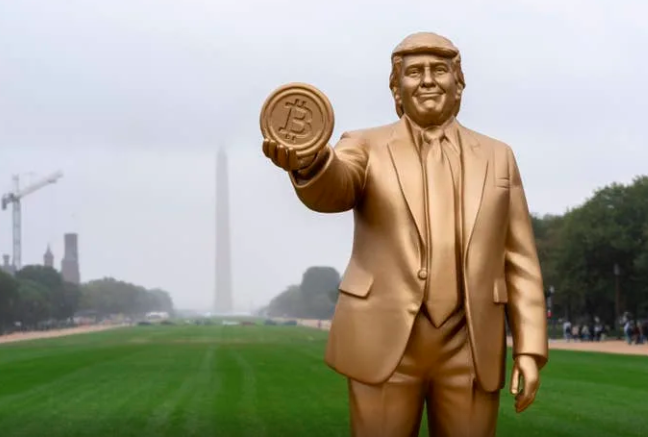
Washington DC, was hit with a news item the morning of September 17, 2025, that was nothing like the political stories from the day. A giant, 12-foot gold sculpture of Donald Trump holding a big Bitcoin up in one hand had sprung up across the street from Union Square, where one could fit both into a single image, near the Capitol dome. But there was no ribbon-cutting, no press release and no listing on public arts calendars. One day suddenly, it wasn’t there. It was the next day and the sun was shining over DC, a fever dream of where American politics and crypto speculation had gone to collide.
It was dubbed the Trump Bitcoin statue almost as soon as it was installed, and its short tenure on the National Mall proved to be more of a reflection on the past two years of crypto culture than a single foam statue could be.
A Golden Giant Appears on the National Mall
The statue was 12 feet tall and was made of dense, hardened foam, not bronze or stone, all for logistical reasons! Foam is light. If someone official asked questions, a small group of people could mold it together in sections, load it in before dawn and remove it by the end of the day, which, as it happened, they did.
One image from the Wednesday reveals Trump in the middle of a push-up gait, an arm outstretched upward with a massive gold Bitcoin token resting on his open palm, as though he’s handing it out to the audience. All in a shiny gold that glittered from a distance. It was located on 3rd Street across from Union Square on the National Mall that extended toward Capitol Hill in such a way that from the right angle, one could fit the statue, the Capitol dome and the Washington Monument all into one view. About a mile west was the White House.
As early as the morning of the second day, videos of the statue already circulated in crypto media, around the DC media, and ultimately into the news of more diffuse outlets, such as ARTnews and Baptist News Global.
The Crypto Crowd Behind the Statue
There was no prominent name that was associated with it in a publicity-worthy manner and most of the people who worked on it were never seen. The only one who did step forward, Hichem Zaghdoudi, was interviewed by ABC’s 7News DC and DC News Now, portraying the statue as being a form of gratitude. He said it was acknowledging Trump’s efforts to make Bitcoin a mainstream financial product, saying to one interviewer, “This is our thank you, this is our statement, to the president.
There was a livestream behind the statue that was constructed around Pump.fun, the Solana-based platform that makes it easy for anyone to launch a token in minutes and has become the go-to solution for meme coin culture. They used a foam-cutting machine to shape the features of the statue, creating anticipation and buzz the way a new product launch would. The statue eventually rose to its feet, and one of the photos captured by the account was just a tribute to our savior. It was time and the organizers took the opportunity to launch a token that they named the Donald J. Trump Golden Statue (DJTGST). It briefly reached around $2.4 million before the typical pattern of these kinds of hype-driven coins came to pass: it got buzzed about in just a couple of hours and the sell-off ensued. The DJTGST timeline was almost a repeat of a previous pattern Crypstudio has seen with the Wolver Inu meme coin.
One host of the live stream responded, “I hope Trump will ‘walk out there and see it’,” presumably not realizing that the president was thousands of miles away that week on a state visit to the UK. It’s possible the statue was intended as a tribute, or it was mostly a pump for a token; and it’s possible the statue was meant to be both. Additionally, several pointed out that the Bitcoin rally actually began under the Biden administration, as spot Bitcoin ETFs were given approval in early 2024, which was not included in any of the promotional graphics for the statue.
Timed to the Minute: A Statue and a Fed Decision
It was no accident that the date was chosen. On September 17, 2025, the Fed lowered its federal funds rate by a quarter point to a 4.00- to 4.25-percent range, marking the first rate cut of the year since December 2024. Cutting rates is often interpreted as positive for risk assets, including Bitcoin, because lower rates tend to spark more money flowing into speculative investments. The organizers of the unveiling of the statue were no doubt aware that they would be getting more attention from a combination of the two rather than just one or the other.
A theme that never ends when it comes to crypto news coming from this administration. Crypstudio has already been monitoring the frequency with which the president’s announcements coincide with market-moving events, and may have been inspired by the same basic playbook, despite not being organized by the White House: tie your message to a moment when the financial press is focused on you.
Seven Hours of Fame, Then a Truck
The statue was erected at about 9 a.m. and removed by about 4 p.m. the same day, just after the lunchtime picnics were finished and the photos were snapped. The Bitcoin statue was not from the anti-Trump satirical statue collective The Secret Handshake, which is responsible for a series of other removals of statues on the Mall. The very same group’s sculpture, titled ‘Best Friends Forever’ and created by Trump and Jeffrey-Epstein, was quickly brought up under its very similar permit and was pulled by the Park Police just before dawn on Sunday, only to have the group’s repeat permit canceled outright. The man who paid for the golden Bitcoin statue expected it to be torn down on the spot and didn’t start anything like that fight for his statue.
Praise, Mockery, and a Golden Calf Debate
Reactions were divided as you’d expect. The joke was embraced by most crypto commentators. It’s a sentiment that was echoed by plenty of Bitcoin bulls when personality Scott Melker posted a tweet that read: The ‘Statue of Liberty’ walked so ‘Statue of Gold Trump With Bitcoin’ could run. Others, not fully serious, called it a nod to Bitcoin’s digital gold status.
It didn’t seem very charming to everyone. Reddit threads dissected the sculpting, one comment that was shared was that Trump’s face looked like the mascot for some breakfast chain. One Baptist News Global columnist, in that column, found himself in a middle-ground state of amusement and unease when he was unable to decide whether the column was an idol or simply a sculpture, and was unable to even decide whether the column was an idol or just a sculpture, but rather, he was troubled by a larger concern among some religious commentators: whether the column was political adoration or something more akin to worship, a discussion that would come back to the fore the next spring around a totally different Trump statue.
The economists weren’t laughing, though. A Financial Times poll of dozens of American and European economists conducted around this time shows there is genuine worry that the pressure central banks feel on the political agenda over time will erode the independence of the Federal Reserve. Whether or not a foam sculpture actually poses a threat to monetary policy is debatable, but the first sign of the moment being loaded is that serious economists were asking that question in the first place.
The National Mall Has Seen This Movie Before
The golden Bitcoin statue didn’t appear in a vacuum. Throughout 2024 and 2025, the National Mall had been in the midst of an odd trend: guerrilla sculpture, much of it smashing and derogatory, but not all, toward Trump. It started in October 2024 with a bronze replica of Nancy Pelosi’s desk topped with a swirled pile of fake feces, a jab at the January 6 Capitol riot. Soon after, there was a fist with a tiki torch, alluding to the Charlottesville rally in 2017. An eight-foot golden hand with a thumbs-up, crushing the Statue of Liberty’s crown, had been placed under the banner Dictator Approved, and quotes from Trump’s praise from Vladimir Putin, Viktor Orbán and Kim Jong Un were carved into its surface by June 17, 2025. It was replaced nine days later with a gilded screen of Trump dancing footage.
In September, the golden Bitcoin statue made it onto the list as the first one this year that was meant as an accolade, rather than a punchline. The distinction didn’t last long. Within a week of its fall, the pendulum had turned, and the Trump-Epstein “Best Friends Forever” statue was erected nearby.
2025 was too fleeting, too. A much bigger tribute, Don Colossus, was unveiled in May 2026 at Trump National Doral in Miami, as a bronze statue covered in gold leaf and standing on its own multi-ton pedestal, in the same pose he struck after the assassination attempt in July 2024 in Butler, Pa. It wasn’t a Bitcoin statue, as in no coin was held by the statue, but it was funded in much the same way as a Bitcoin project is funded, by cryptocurrency investors hoping to promote a token, this time one called $PATRIOT, and its path to completion was so rocky that the sculptor publicly announced that he is still owed about $92,000, months after the unveiling, and the Trump Organization sought to publicly distance itself from the coin. The Bitcoin statue and Don Colossus had clearly created a trend: crypto supporters had discovered that a large gold Trump is among the safer methods to develop buzz for a new token.
Why Bitcoin, Why Trump: The Policy Behind the Punchline
All of this does not occur in the absence of the real policy change that it is supposed to represent. In the first few weeks of his presidency in January 2025, Trump signed an executive order that paves the way for more friendly crypto regulation, and on March 6, he signed a second one that mandates the Treasury keep the Bitcoin it already possesses, via criminal and civil forfeitures, and not sell it off as past administrations had done. Around 200,000 Bitcoin valued at tens of billions of dollars, officials estimated, were housed within the government at the time and they are referring to the reserve as a way to make Bitcoin like the government does with gold, a strategic asset. White House cryptocurrency adviser David Sacks linked the initiative to the creation of America being the crypto capital of the world, which has become an almost official line of business for the Administration.
The policy was to go hand-in-hand with the Trump family’s own crypto presence. The memecoin $TRUMP, manufactured by Trump himself, was launched less than a week before his January 2025 swearing-in ceremony. His sons also became involved with World Liberty Financial, a decentralized finance firm whose WLFI governance token was held in a non-transferable holding pattern since a presale in 2024, which opened up to public trading only two weeks before the Bitcoin statue was unveiled on September 1, 2025. If you don’t know what a token such as WLFI is offering its users, then Crypstudio’s explanation of the mechanics of decentralized finance does a great job of detailing the differences between a standard bank and a token platform, as well as where the dangers can lie.
Add them all up, and the statue isn’t some random meme anymore, but more of a by-product of the times: a sitting president with policy, personal gain, and campaign messaging surrounding crypto, in an age where anybody with a foam cutter and a Pump.fun account can make an association into a headline in days.
The Real Lesson for Everyday Crypto Holders
All the hype aside, there is a lesson to be learned: a practical lesson. Whenever something happens in Trump’s orbit, whether it’s the party’s gold sculpture, speculation about a new coin, or a chance comment at a rally, a flood of copycat tokens launches in hours or days within hours in hopes of riding the wave. Some of them take the ticker, some of them take the imagery, and a lot of them are set up by people who have nothing to do with anything whatsoever. One small, relatively isolated instance of that pattern was DJTGST. Hardly a tribute coin for a celebrity or politician comes out that doesn’t go up strongly the day it’s released and drop off during the subsequent weeks as early buyers realize their investment is a bubble.
None of that makes the underlying technology the problem. It simply means that the most active part of crypto is the meme coin part, and the most difficult part to distinguish a scam from legitimate speculation from the outside. If you are about to send any money to a token that all of a sudden has a golden statue attached to it, here are a few things to check before you do: First, check the token’s contract address to see if it is the one they are advertising. Secondly, check if liquidity is locked in the token. Thirdly, check the wallet history of the wallet you are sending to, to see if there is any flagged activity. That’s exactly the kind of check Crypstudio’s wallet and address scanner was built to handle, and it takes a lot less time than explaining to future-you why a golden foam president once seemed like a sound investment thesis.
What Outlasted the Statue
A year later, that very statue has disappeared, no doubt to the storage unit containing the remains of retired foam sculptures. Bitcoin has had its share of bumps and bruises in the road, however, to the tune of the gold paint it seemed it would; the euphoric sentiment that followed that rate cut in September had quickly shifted to a far more choppy market, with BTC trading well below the recently hit $117,000 mark. DJTGST quickly dropped from watchlists after its debut.
What remained was the pattern of the statue. But crypto culture has become very good at creating things and physical objects and shareable and meme-worthy out of the president’s policy preferences, and this administration has given it just as much as has ever been given before. That is likely to continue until the Strategic Bitcoin Reserve is eventually replaced by some golden gift that appears on a golf course or national landmark in the process. The statue outside the Capitol was never for Trump, ever for Bitcoin. It was the example of how one could create a moment in online crypto culture, how it could then be packaged in gold foil and used as a political statement and campaign before lunch.
